

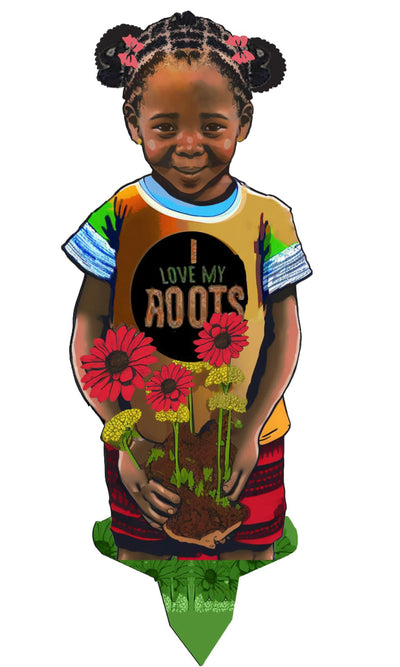
The Methodology Of Traci Mims

Traci Mims on printmaking, cultural memory, and the importance of telling our own stories.
By: Peyton Shepard
If you remember one thing about the ethos of Traci Mims, let it be this:
“My work is a reminder to never forget who you are and where you come from. Our stories are important. Ourselves are important. And if we don’t tell our own stories, who will?”

At first glance, Traci Mims's woodcut prints draw the viewer in with their rich colors, intricate patterns, and carefully composed figures. But beneath their visual appeal lies a deeper intention. Working primarily in color reduction woodcuts, Mims employs a meticulous, often time-consuming practice that requires her to think through an image in reverse, carefully considering how each layer will contribute to the final print.
Mims approaches beauty as an invitation, encouraging viewers to look closer and engage with the histories and experiences embedded in her imagery. Though she makes beautiful works, beauty is not the destination but the vehicle to her point.
“The way I work with the woodcut, I do it to get attention. It's like when you dress up, and you make it pretty. So I make it pretty to draw you in, but then you see there's a story there. And I want people to look at it and question, and question themselves and get something from it.”
Through her printmaking practice, Mims brings personal narratives, collective memory, and the realities of Black American life into view.
After earning her MFA in Printmaking from Temple University, Mims began taking the medium she had studied years earlier more seriously. As a single parent supporting two children in college and another at home, the relative affordability of the materials was an important consideration.
“And woodcut was really the most accessible; you can go to Home Depot and buy a sheet block of wood … it was just economical.”

Mims begins with digital renderings on her iPad and drawings in her sketchbook before transitioning her composition to the woodblock. She draws her image in Sharpie on the board and then, with fine gouging tools, carves away the parts of her image that will remain the white of the paper. She repeats the process with each successive layer of color per sheet, working from light to dark, continuing to reduce the block after the lifting of each image. This makes the image relatively impossible to reproduce once that color is cut away. Once the block is inked, she uses padded baren tools - think of a pestle made of soft, worn leather - and a metal spoon to transfer the image onto paper by hand, working section by section to control the pressure and texture.

“I am applying pressure (to the metal spoon). I didn't go to the gym today, so this is the substitute. And so I just do one area, and when I think it's done, I’ll rotate it, and I keep rotating it. It'll probably take me at least one hour to lift an entire image.”
Individual layers can take weeks or even months to dry before the next can be printed, and each sheet must be carefully aligned with the block. Mims deliberately avoids a mechanical press, preferring the texture and evidence of her own hand that emerge through hand-printing. She also embraces the slight imperfections that occur along the way.
“Not perfect all the time, but I'm okay with that. That's the character to it.”
For Mims, the labor is inseparable from the purpose. Her ability to produce multiple impressions reflects an intentional choice about who gets to experience her work and how widely it can circulate. She wants her work to be seen, to educate, and to bring attention to our histories. The time invested in each print is considerable, but, as she puts it, “There's easier ways to do this, but I wouldn't get the same result.”
A true testament to her connection to her craft is a limited-edition woodcut titled Kitchen Table, which was a refuge for Mims during cancer treatment last year.

“I just kind of sat down and drew that one out, and it was kind of therapeutic to sit there, carve… I just needed something to do at that time. I would just sit there, and when I had enough energy, I would carve.”
The 48 x 48 inch woodcut is printed upon hand-stitched paper that Mims made herself and explores domesticity, family, and tradition. The work's main figure is a Black woman seated at a table cutting a slice of pie. This scene feels familiar, recalling the small but significant rituals that occur in and around the kitchen, much like the sweet potato pie made from my grandfather's cookbook that has become my responsibility for the holidays. The hand-stitched paper recalls the textile traditions passed down by her mother and aunt, who made Mims’s childhood clothes and worked creatively with textiles. These everyday acts of making and sharing are often how family histories are passed down, becoming traditions that connect generations.

Her commitment to remembrance of our past is evident in Rooted and her ongoing series Where We Landed. Rooted is a woodcut relief print that is currently being shown next to its original woodblock at Black Art In America Gallery. The central figure is a young Black woman, her gaze drawn upward, her graphic T-shirt on full display. The shirt displays the portrait of a young Claudette Colvin. At just fifteen, Colvin refused to surrender her seat on a segregated bus, months before Rosa Parks's more widely publicized act of resistance. Despite her role in the struggle against bus segregation, Colvin was not embraced as the public face of the movement.
“I'm trying to tell a story. Trying to get you to see something or remember this history. Don't forget this, don’t let people erase that. Because it's important and it's relevant. And if you allow it to be erased, it's going to keep recurring.”
Mims's ongoing series Where We Landed turns toward the present. Reflecting on the work, she describes a recurring cycle of displacement:
“I was kind of thinking about displacement and how Black people kind of go through the same loop over and over again. Displacement. And not being able to grasp hold of or take root anywhere because of that. And then I thought about how do we come out on the other side of that, where do we land?”

Mims does not believe art should be limited to uplifting narratives; she wants to highlight truths. As she states:
“And so if you're saying, oh, we only want to see this type of image because it's uplifting. That's not truth, and that's not honest. We endure all this oppression in the US, discriminatory laws, and all this persecution. No matter how you dress it up, it's still there.”
Mims's practice is informed by printmaking's long history as a medium of protest, resistance, and cultural preservation. She understands her work as an extension of the artistic legacy of those who came before her, particularly artists who have used the medium to document and challenge the conditions of Black life. While studying, Mims was inspired by artists such as Charles White, Jacob Lawrence, John Biggers, and Elizabeth Catlett.
“…especially with Elizabeth Catlett because she was very socially conscious as an artist, and not only that, but she believed in doing the work at a high level.”
Catlett's series of linoleum cuts, The Black Woman, depicted the everyday realities, achievements, and fears of Black women, including historical figures such as Sojourner Truth, Harriet Tubman, and Phillis Wheatley. Her example resonates with Mims's desire to create enduring, socially conscious art. Beyond their shared commitment to representing Black experiences, Mims's admiration for Catlett extends to the rigor of her practice. For both artists, the significance of the subject is matched by an insistence on the quality and intention.

Mims also looks to artists whose contributions she believes deserve greater recognition. Among them is Nefertiti Goodman, a printmaker whom Mims feels ‘never really got her due.’ Like Mims, Goodman's work gives attention to the interior lives of Black women, a subject that also runs throughout Mims's own imagery. For Mims, carrying the torch means acknowledging the full breadth of the artistic lineage that has informed her practice, including those whose influence might otherwise go unrecognized. These artists, celebrated and overlooked alike, come together in her work.
“That's why I say the art that I make isn't necessarily for myself. It's to preserve history, to teach a little bit, and to inspire, like I was inspired by artists to carry on what they were doing. And that's how it should be; it should go forward.”

For Mims, this sense of continuity extends beyond the artists who have shaped her practice; it is equally rooted in her own family's histories and traditions. Through her own research, Mims has come to understand ancestry not simply as a record of names and relationships, but as a way of recovering the lives, labor, and experiences of those who came before her.
“And when you research it, you really appreciate it. It gives you so much insight and respect for your people. My mom's grandfather was a berry picker as his main occupation with 17 children.”
For Mims, artistic legacy is not simply something to inherit, but something to continue.
Source: Traci Mims, interview by/in discussion with Peyton Shepard at the Atlanta Printmakers Studio on Wednesday, October 28, 2026


