

Najee Dorsey: Building the House While Painting the Walls
Najee Dorsey: Building the House While Painting the Walls
By Halima Taha


Najee Dorsey’s installations unfold like memory made material—rooms assembled from pigment, fabric, metal, paper, and found objects that breathe history into space. Figures rise from layered canvases and photo montages as if lifted from family albums and ushered gently into the present: elongated silhouettes, richly hued skin, gestures that feel both everyday and monumental. Color moves through these environments like weather—warm umbers, oxbloods, verdant greens, and sunlit ochres forming atmospheres so dense they seem to hum with their own internal music.
His surfaces operate as palimpsests. Photographic strata, hand-tinted tintypes, and contemporary portraits fuse into faces that feel both specific and timeless—time travelers carrying domestic objects, migration routes, and ancestral songlines on their skin. Dorsey’s interiors feel lived-in: a pot belly stove anchors a hearth, an old radio keeps vigil, a tilted photograph hangs on a salvaged wall. Roofing tin cut like wings, battered juke joint signage, jars of fireflies, cotton bolls, irons, pool balls, pistachio shells, and train markers appear as mnemonic devices—small vessels of labor, memory, and survival stitched into the larger cloth of communal history.
The pot belly stove recurs as a quiet icon—sturdy, stubborn, born from his mother’s childhood in rural Arkansas, where dawn meant gathering firewood to keep the family warm. Biographical detail expands into art-historical resonance: like Horace Pippin’s hearths or Romare Bearden’s trains, Dorsey’s stove anchors personal recollection within a broader history of Black endurance under winter’s threat and economic precarity. Cotton, rail signage, and train imagery trace the arc from forced labor to northern migration; banjos and guitars register African continuities and blues routes, while juke joint interiors pulse with remembered rhythm.

Over the years, Dorsey’s figures have shifted from technically accomplished renderings into fully embodied personalities—subjects with their own weather and temperature. In this, he joins a lineage of Black figuration in which the painted body becomes historical record: from the Harlem Renaissance painters David Driskell documented in Two Centuries of Black American Art, through Jacob Lawrence’s migration epics and Bearden’s collage cosmologies, to Kerry James Marshall’s monumental meditations on Black presence. Dorsey’s work participates in this continuum as a visual conscience, insisting that Black domestic, spiritual, ecstatic, and burdened lives be seen and remembered.
Color in his work is a living force. Saturated hues—earthy reds, deep blues, velvety browns, glowing golds—carry heat, humidity, and emotional gravitas, guiding the eye from interior to landscape, from intimate domesticity to mythic crossroads. Sartorial detail—dandified coats, crisp hats, patterned collars—becomes an assertion of dignity and self-making, an elegant retort to reductive stereotypes. A tilted head, folded hand, or carefully placed pocket square becomes a vessel of narrative weight.
The exhibition’s movement—from interiors to crossroads, to landscapes, to dandyism, and finally to Black love—echoes an art-historical arc from early twentieth-century domestic scenes to contemporary installation. Dorsey’s interiors, dense with iconography, recall Bearden’s staging of Black memory, yet they remain rooted in the rural South of Arkansas, Louisiana, Mississippi, New Orleans, and St. Louis—a geography that is both personal and collective, intimate and mythic.


His engagement with photography situates him within the ongoing dialogue around Black photographic representation. The “art family” series and tintype-like portraits build on a tradition running from Frederick Douglass—nineteenth-century America’s most photographed man—through Lorna Simpson, Carrie Mae Weems, and Lyle Ashton Harris. Vintage family photographs and newly entrusted archives—such as a box of images given by a ninety-two-year-old woman wishing to honor her friend—interweave with portraits of scholars and cultural workers, including Samella Lewis and David Driskell. By digitally reworking these images into contemporary “tintypes,” he collapses past and present, echoing the function of photographic souvenirs as vessels of both historical time and particular lives.
This is not a derivative echo of Njideka Akunyili Crosby’s photo-based interiors. Dorsey’s “family walls” emerge from a deeply Southern Black tradition of home altars of memory—a genealogy wall of ancestors and mentors—rather than from Crosby’s diasporic, Nigerian dual-location narrative. Without critical writing and documentation, this distinction risks erasure, inviting careless attributions that obscure more than a decade of his development of this visual language.
Installed as environments, his works converse across mediums: paintings answer photographs, sculptures echo textiles, and the exhibition becomes a charged field of histories. Here he stands alongside contemporary installation artists such as Rashid Johnson, whose arrangements of plants, books, shea butter, and tile create emotional and intellectual landscapes, and in kinship with Whitfield Lovell, whose shack-like interiors carry palpable gravitas. Dorsey’s spaces are vivid evocations of Black Southern life—lined with radios, irons, vintage photographs, pot belly stoves, family portraits, flags, and hand-painted images that speak across generations.

One large mixed-media figure, studded with pistachio shells that recall scarification, evokes both Central African nkisi power figures and contemporary Black visual culture, where younger viewers might see the echo of Killmonger’s ritual scars in Black Panther. Cotton, American flags, cargo ship silhouettes, Dixie signage, and tools of forced labor gather across its surface, yet its layered, patchwork arms read almost as wings—“and still we rise”—despite the historical weight it bears.

The crossroads series is anchored in the legend of Robert Johnson, but Dorsey expands the metaphor far beyond a single bluesman at a dirt-road junction. The crossroads become historical, ethical, and existential decision points: the migration of music from Congo Square to Kansas City’s 18th & Vine; the sale and consolidation of Black-owned institutions; the choices facing each generation of Black families. In dialogue with Kerry James Marshall’s reference to William Tucker (the first recorded African child in the colonies), Dorsey imagines When William Slim Tucker Discovered the Crossroads, centering the banjo—an instrument with African roots—as a sign of cultural transmission.

A powerful work introduces the first woman at the crossroads, a departure within his iconography. She stands amid symbols of infancy, childhood, and adulthood, evoking rites of passage and the familiar story of the one who “left home and made good,” yet remains the person the family calls in crisis. As Black woman, Muslim, and cultural worker, she is caught between corporate success, economic security, and the demands of conscience at a moral and spiritual threshold. The piece recalls nineteenth-century allegorical painting, where hand positions, jewelry, and backgrounds encoded social status, yet Dorsey refuses class display as the final subject; instead, he stages a psychological and ethical drama rendered through color, posture, and surrounding symbols.

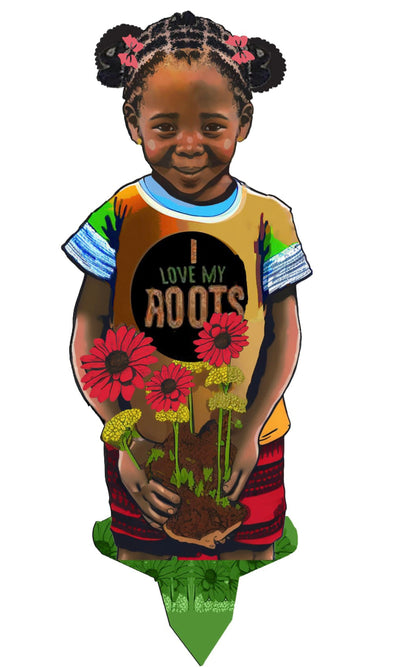
Elsewhere, Shine a Light places James Baldwin as an almost prophetic presence, flashlight trained on an American flag watermarked “love / hate / Black people.” At the base, a child rooted in Black liberation colors and family land unscrews the lid from a jar of fireflies—a small but potent gesture of liberation, the first refusal to trap light. The work meditates on how Black children come to consciousness in a nation that both consumes and resists them, echoing Baldwin’s own confrontations with America’s love-hate relationship to Black life. Juke joint scenes, musicians, vernacular architecture, and portraits of community figures mingle with scenes photographed in places like Miami, mapping a living terrain of Southern and diasporic Black culture.

Sound haunts the visual field. Rail cars evoke migration routes that transported both people and music; the crossroads conjures Johnson’s mythic bargain, reframed as a human threshold where personal and collective histories meet. In Dorsey’s landscapes and interiors, music becomes visible—strings suggested by paint strokes, rhythms implied by repeated motifs—so the viewer feels the cadence of generations moving through rooms and streets.
Over the last fifteen years, Dorsey’s practice has expanded in scale, medium, and institutional reach. His work now spans painting, mixed media, digital collage, photo montage, ceramics, sculpture, and full-scale installation, appearing in museums, universities, and corporate collections. As founder and CEO of Black Art in America (BAIA)—a media platform, gallery, and sculpture garden in Atlanta—he has become a key figure in the documentation, promotion, and preservation of African American visual culture. He champions emerging and mid-career artists, produces and participates in art fairs, and cultivates a broader collector base, all while maintaining an evolving studio practice.

Dorsey’s position is akin to that of a composer who writes the score, builds the concert hall, and trains the orchestra, yet is remembered primarily as impresario rather than author of the music. In African American art history, James A. Porter, David C. Driskell, and Samella Lewis accepted versions of this bargain: they named, organized, and historicized a field the larger art world refused to see, often at the expense of their own studio practices. Dorsey stands in this lineage, but with a crucial difference—he continues to produce a substantial body of work even as he architects platforms and markets for others. To acknowledge him only as cultural entrepreneur is to mistake the concert hall for the composition.

Unlike Driskell, and Lewis—who shouldered their responsibilities largely as individuals within predominantly white institutions—Dorsey has intentionally built BAIA as a Black-controlled ecosystem with a full-time professional staff and, critically, a life partner, his wife Seteria, whose business acumen and co-leadership undergird every facet of the enterprise. Her partnership ensures that the operational and strategic demands of BAIA are carried by a team rather than by the artist alone. This shared infrastructure—marital, organizational, and communal—marks an evolution in the lineage you trace. If Porter, Driskell, and Lewis were singular torches lighting the way, the Dorseys function more like a relay and a grid: a power couple whose partnership makes it possible for Najee to remain a full-time artist while continuing the tradition of advocacy, scholarship, and institution-building on which the field depends.

Alongside the gallery and media platform, Dorsey has established the Black Art in America Foundation, a nonprofit dedicated to education, access, and preservation in African American visual culture. The foundation extends BAIA’s mission beyond the marketplace, supporting public programs, collector and artist education, internships, mentorships, and initiatives that place Black art into schools, community spaces, and public collections. It underscores that Dorsey’s project is not simply to sell work but to build sustainable ecosystems of knowledge, stewardship, and opportunity.
In Dorsey’s hands, material culture becomes narrative architecture—vivid, tactile, and insistently alive—staking a firm place within the canon of African American art while extending it toward new crossroads of form, geography, and collective imagination.
C 2026 halima taha/tahathinks, LLC


